


Last updated
According to the Twistly State of AI Presentations 2026, nearly a quarter of presentations teachers create are made on Saturday or Sunday, compared with 19% for marketing and sales.
Ask a teacher when they build their lessons, and you will rarely hear “during the school day.” The timetable is full of teaching, marking, supervision and meetings, so preparation drifts to the edges: evenings, early mornings and, as new data now shows, the weekend.
This article looks at what that number says, what it does not say, and what it means for how to avoid teacher burnout: practical ways school leaders and teachers can cut weekend preparation without cutting lesson quality.
The headline number
24% of the presentations teachers make are created on a Saturday or Sunday.
That is close to one in four slide decks, built on the two days most of the workforce treats as time off. For a profession whose working week is already widely described as longer than its contracted hours, the figure lands in an existing conversation about unpaid preparation time.
How teachers compare with other groups
The report places teachers in the upper half of the groups it measured, though not at the top.
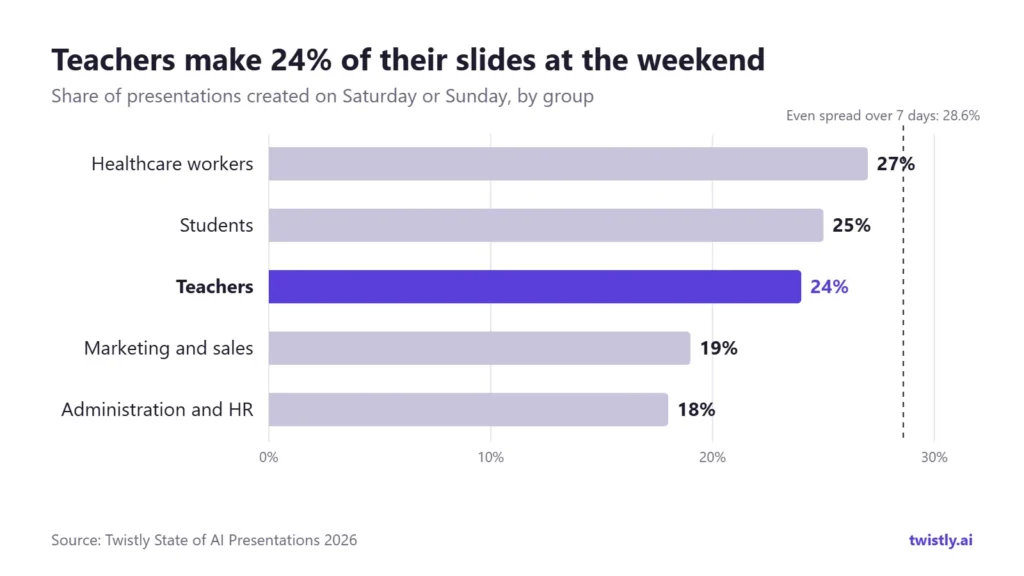
| Group | Share of presentations created at the weekend |
|---|---|
| Healthcare workers | 27% |
| Students | 25% |
| Teachers | 24% |
| Marketing and sales | 19% |
| Administration and HR | 18% |
A few points stand out.
The gap is real but not enormous
Teachers sit six percentage points above administration and HR, which means their weekend share is about a third higher in relative terms. Against marketing and sales, the difference is five points.
Teachers are in good company
Healthcare workers lead at 27%, which is unsurprising given shift patterns, rotas and on-call duties that do not follow a Monday-to-Friday rhythm.
Students, at 25%, are slightly above teachers. For them, weekends are the natural window for coursework between lectures and part-time work.
No group is under 18%
Even the lowest-ranked groups produce nearly one in five presentations at the weekend. Weekend slide-making is common across knowledge work, not a teacher-only habit.
What distinguishes teaching is the context: the weekend work is rarely optional, rarely recorded and rarely paid.
Monday is the busiest day
The report also finds that Monday is the single busiest day for teachers when it comes to creating presentations.
It is tempting to read this alongside the weekend figure. A teacher who finishes planning on Sunday evening and tweaks the deck before first period on Monday is a familiar picture. The data is consistent with that pattern, though it does not prove it.
What the figures show is that creation activity clusters around the start of the week, and that a substantial share of it happens before the week begins. Why it clusters there is an interpretation, not a finding.
What the number does not tell us
Good reporting on this statistic should be clear about its limits.
- It measures presentations, not total workload. Teachers also mark, plan, write reports, contact families, and handle administration. Slide-making is one visible slice of preparation.
- It is a share, not an hour count. A 24% weekend share says how the presentations a teacher creates are distributed across the week. It does not say how long weekend sessions last or how many hours a teacher works.
- It does not establish cause. The data cannot say whether teachers choose weekends for focus and quiet, or because the school week leaves no room.
- It is not a burnout measure. The figure describes when work happens. Linking it to wellbeing outcomes would require evidence the dataset does not provide.
It is also worth noting that a perfectly even spread of activity across seven days would put 28.6% of output on Saturday and Sunday.
All five groups sit below that line. Weekends are lighter than weekdays for everyone, teachers included. The notable point is that for teachers, as for others, the weekend is still far from empty.
Teacher Workload: Weekend Prep Is About More Than Time Management
It is tempting to interpret weekend work as a personal time-management issue. However, the responsibilities involved in preparing educational materials are closely connected to the structure of teaching itself.
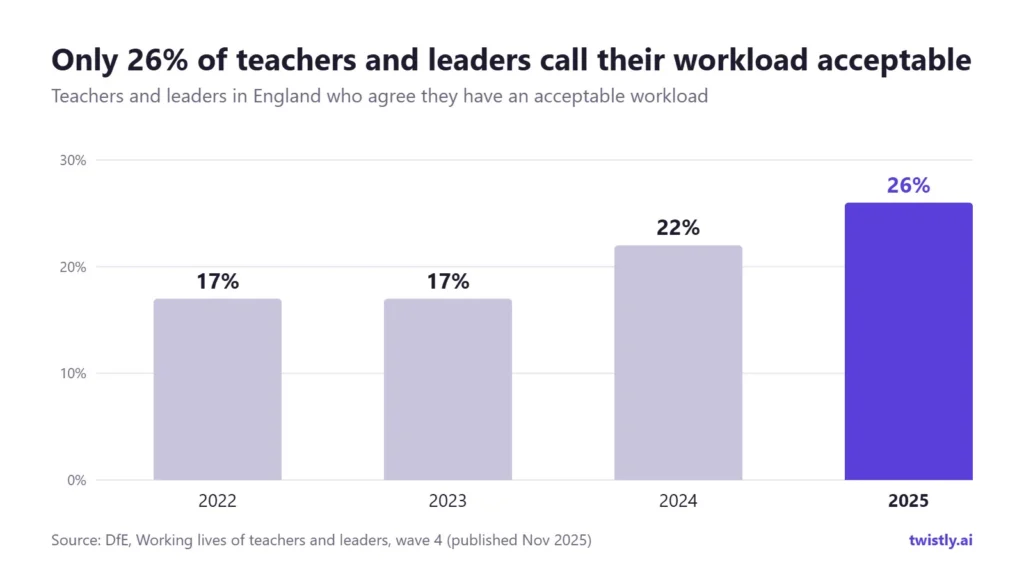
National data points the same way. In England’s Working lives of teachers and leaders survey (wave 4, 10,808 teachers and leaders, published by the Department for Education in November 2025), full-time teachers reported working an average of 50.1 hours in their most recent term-time week, and just over one in four (26%) agreed they had an acceptable workload. Among those considering leaving the state sector, high workload and stress or poor wellbeing were the two most cited reasons, each reported by 89%.
Teachers work with different student abilities, curriculum requirements, learning objectives, and classroom conditions. A presentation needs to serve a particular educational purpose. It cannot always be produced quickly by copying information from a textbook or placing paragraphs on slides.
Consider a teacher preparing a presentation for a new science lesson. The work may involve:
- Identifying the most important concepts students need to understand.
- Breaking complicated information into manageable sections.
- Finding suitable diagrams, illustrations, and examples.
- Creating charts or visual explanations.
- Checking factual accuracy and subject-specific terminology.
- Arranging the slides in a logical teaching sequence.
- Preparing questions and discussion points for classroom interaction.
Each task contributes to the quality of the final lesson. But together, they create a substantial preparation process.
The same applies to teachers working across several subjects or grade levels. Their presentation requirements may vary considerably throughout the week, making it difficult to rely on a single reusable template or fixed set of slides.
How to Prevent Teacher Burnout from Weekend Prep
Teacher burnout has many causes, and slide-making is only one of them. But for the weekend-prep part of teacher workload, a few changes at school and personal level can help:
- Protect planning time in the week. School leaders can timetable planning blocks so that preparing next week’s slides has a home on a weekday, not on Sunday.
- Share and reuse decks. A department bank of lesson presentations means each teacher adapts a deck instead of building one from scratch.
- Agree a “good enough” standard. Slides support the lesson; not every lesson needs a new, polished deck.
- Batch preparation. A fixed weekday slot for next week’s slides stops weekend prep from becoming the default.
- Make weekend work visible. Leaders can ask staff when preparation actually happens; data like the 24% figure is a starting point for that conversation.
- Use AI for the first draft, not the final say. Let a tool do the mechanical work and keep the teaching decisions yourself, as the next section explains.
AI Solutions for Teacher Burnout: Can AI Tools Cut Weekend Prep?
AI presentation tools offer one possible way to reduce the time required to create teaching materials. Instead of building every slide manually, teachers can use AI to turn a topic, outline, document, or existing learning resource into an initial presentation.
For example, a teacher preparing a lesson on climate change could provide a topic or upload a document and use an AI presentation maker to generate an organized slide deck. The teacher could then review the content, adjust explanations, add relevant examples, and customize the presentation for the students.
This approach can help with several time-consuming parts of presentation development.
Faster first drafts: Twistly builds a deck from a topic or from pasted text or a file, so the starting point is a structured draft rather than a blank slide.
Reusing existing resources: Lesson notes, worksheets and schemes of work can be uploaded as .pdf, .docx, .pptx, .txt, .xlsx, .xls or .html files of up to 300 MB. Images in the document are reused where they fit, and long documents are condensed rather than copied page by page.
Visuals without the search: Decks can use AI-generated images, licensed stock photos from Pexels or web images. Web images need a usage-rights check before they go into shared material.
Simplifying complex information: On paid plans, Edit Text with AI can simplify language, shorten text or translate a slide without changing its structure.
The teacher stays in control: Every slide is shown for review before the deck is built, so you can edit text, reorder or delete slides and correct chart values first.
Consistent formatting: Pro and Team plans can upload a school template (.pptx or .potx), so decks across a department share one look.
Reducing Preparation Time Does Not Mean Reducing Teaching Quality
There is an important distinction between making presentations faster and making them less thoughtful.
Teachers should not have to sacrifice educational quality to save preparation time. A well-designed presentation needs to support the lesson’s objectives, explain concepts accurately, and help students engage with the subject.
The potential benefit of AI is that it can reduce the mechanical effort involved in producing slides, leaving educators with more time to focus on reviewing content, adapting lessons, and supporting students.
If a teacher spends less time arranging text boxes, searching for images, or formatting repetitive slides, that time can be redirected toward activities that require actual teaching expertise.
Key takeaways
- 24% of presentations teachers create are made on a Saturday or Sunday.
- Healthcare workers (27%) and students (25%) are slightly higher; marketing and sales (19%) and administration and HR (18%) are lower.
- Monday is the single busiest day for teachers creating presentations.
- The data describes when work happens, not how much work there is or how teachers feel about it.
- Nationally, full-time teachers in England report a 50.1-hour week, and only 26% say their workload is acceptable (DfE, 2025).
Win back your weekends.
Turn lesson notes, a worksheet or just a topic into an editable first-draft deck with Twistly Online, then review every slide before you teach it.
Conclusion: Avoiding Teacher Burnout Starts with the Weekend
According to the report, 24% of presentations teachers create are made on a Saturday or Sunday: nearly one in four teacher decks is produced outside the Monday-to-Friday week. That figure is not a burnout measure, but it shows where part of the teacher workload behind burnout sits.
Learning how to avoid teacher burnout means action at school level, such as protected planning time and shared resources, as well as personal habits that give teachers a better work-life balance. Cutting the mechanical part of slide-making is one practical piece of that, and it is the piece AI tools for teachers can help with: drafting the deck, reusing existing lesson materials and handling formatting, while the teacher keeps control of the content.
You can try this in Twistly Online in the browser. Teachers who prefer to work inside PowerPoint can use the Twistly add-in instead.
Sources
- Twistly, State of AI Presentations 2026 (first-party data).
- Department for Education (IFF Research), Working lives of teachers and leaders: wave 4, summary report, published 27 November 2025, retrieved 25 November 2026.
- Twistly documentation, docs.twistly.ai (From Text or a File, Images, Edit Text with AI, Review & Edit, Upload Your Template), retrieved 13 November 2026.







Start Making AI Presentations in Seconds
Instant Access
Begin exploring Twistly’s full suite of features immediately
No Commitments
No credit card required, and you can cancel anytime
Dedicated Support
Our team is here to assist you every step of the way during your trial.